AI pilots stall without context
MIT's NANDA initiative found 95% of enterprise generative AI pilots falling short of measurable business impact. The authors pointed to a learning gap, not model quality.
Source: Fortune, August 2025
Winner of Innovation of the Year and Best Use of AI at the Open Banking Expo awards.

A company brain is a layer that sits beneath the tools you already use. It reads everything your business knows, works out what it means and how it fits together, and gives your AI the context it needs to do real work.
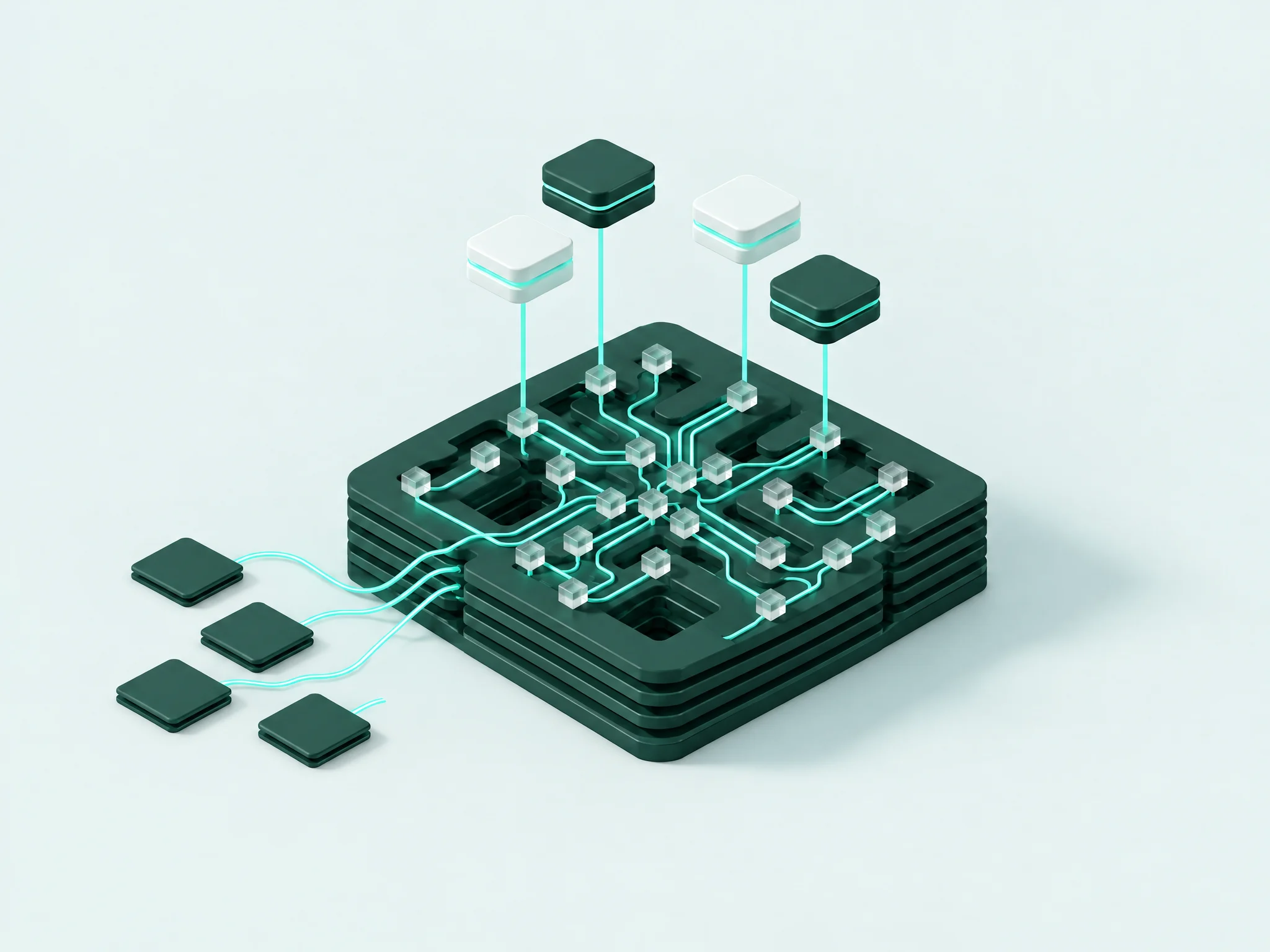
Everything your business knows is written down somewhere, but it is scattered and disconnected, and how it all relates usually lives only in people's heads.
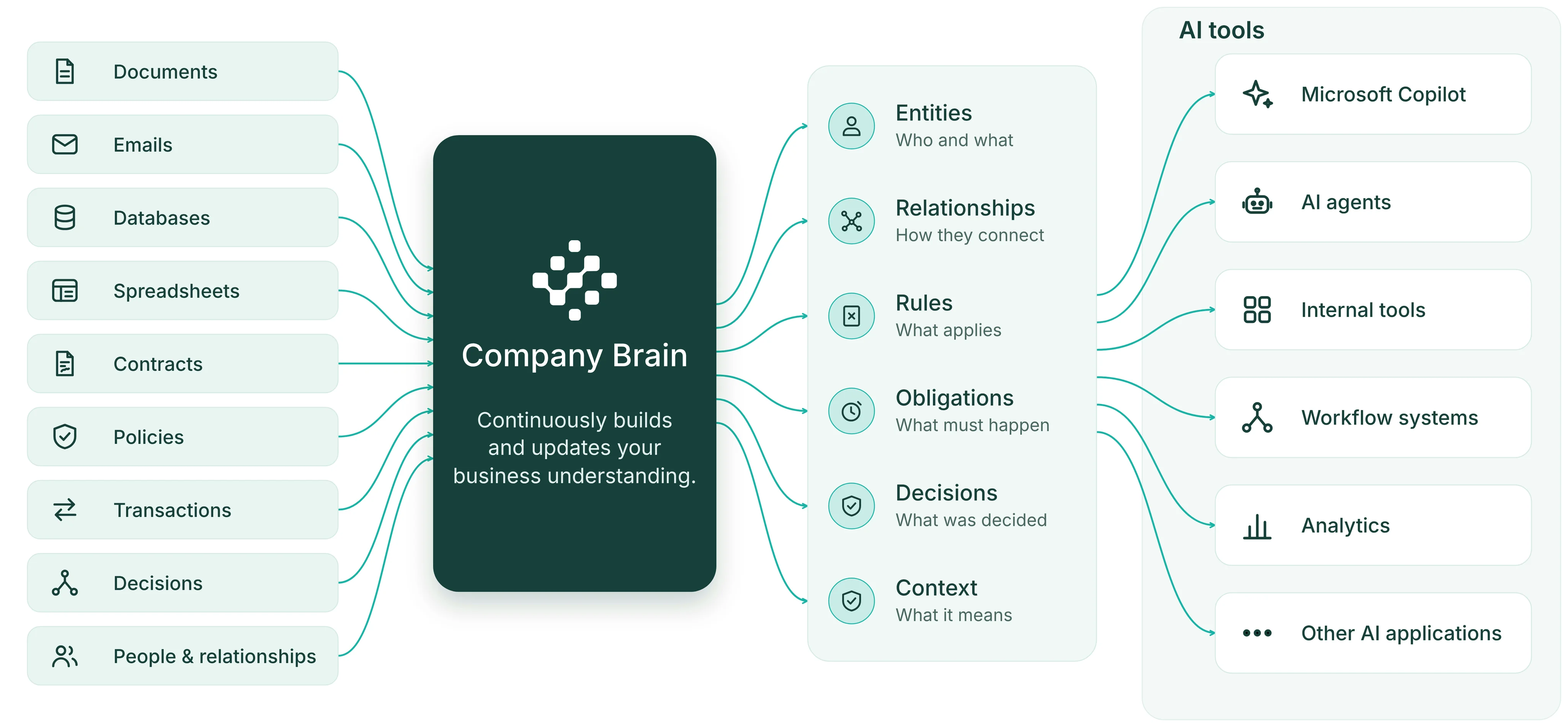
Most AI can tell you who a contract is between and when it was signed. A company brain understands the contract: the obligations it creates, the rules that apply, the people involved and how it connects to everything else.
| It is not | Because |
|---|---|
| A wiki or intranet | A wiki depends on people stopping work to write things down, and goes stale the moment they stop. |
| Enterprise search | Search finds where information is. A company brain understands what it means. |
| Another chatbot | It does not ask your people to go somewhere new. It works beneath the AI you already use. |
| A data warehouse | A warehouse stores structured records. A company brain also understands unstructured content and the rules that connect it. |
Most company brains look alike in a demo. The differences show up in production, when an answer is challenged, something is wrong or the business changes.
Every answer should trace back to its source, the rule applied and the decision made. An answer without proof is just a guess.
A fix should apply everywhere the mistake would otherwise appear. A system that repeats an error until someone spots it is not learning.
Many AI tools reread the raw data for every question. That costs compute each time, and the same question can come back with a different answer.
When a policy, price, contract or regulation changes, the understanding should update everywhere it matters and flag what now conflicts.
The full briefing sets these against typical AI across six situations, plus eight questions to ask any vendor. Get the briefing
MIT's NANDA initiative found 95% of enterprise generative AI pilots falling short of measurable business impact. The authors pointed to a learning gap, not model quality.
Source: Fortune, August 2025“A useful answer is not enough if the basis for it cannot be reconstructed.” The FCA's review also names neuro-symbolic systems as an emerging architecture that may help.
Source: FCA, The Mills Review, July 2026Y Combinator put company brain on its 2026 Requests for Startups, arguing that domain knowledge, not the models, is the biggest blocker to AI automation.
Source: Y Combinator, Requests for StartupsA company brain is a layer that sits beneath the tools you already use. It reads everything your business knows, works out what it means and how it fits together, keeps that understanding current, and gives your AI the context it needs to do real work.
Search finds where information is. A company brain understands what it means: the people, agreements, obligations and rules involved, and how they connect. It also updates that understanding when something changes.
No. Retrieval-augmented generation (RAG) finds passages at question time and asks a language model to interpret them, fresh on every query. A company brain interprets once, stores that understanding in a structured, versioned model and updates only what a change affects.
No. It works beneath the AI tools you already use, so your people keep their current tools and workflows. Onteric's Release 1, opening to beta customers from December 2026, is designed to connect to tools such as Microsoft Copilot through the Model Context Protocol (MCP) and APIs.
Neuro-symbolic AI. Language models propose how a source should be read, then symbolic rules check that meaning and record how each conclusion was reached, so answers can be traced to their source and rule.
Start with one workflow where teams repeatedly find, check and reconcile the same information. Connect the sources that workflow relies on, and the company brain builds its understanding from your own data. You can then add further workflows, tools and systems as you need them.
You can go live and see value in one week. This includes all our out-of-the-box connections, such as Xero, email and OneDrive. Additional APIs are then built and added for any further tools or systems you need to include.
25 pages for leaders and CTOs, written so anyone can follow it.
Results from Onteric's document intelligence, the neuro-symbolic technology the company brain is built on. Actual savings depend on the workflow and deployment.
What a company brain is worth, how to judge one, and the questions to ask before you choose.